
Screens are an easy source of entertainment, especially when children are tired, restless, or simply don’t know what to do. But not every moment of boredom needs to be filled with a video or a game. Sometimes, having fewer ready-made distractions gives children the opportunity to create their own fun.
A cardboard box can become a spaceship. A few crayons can turn into an afternoon of storytelling. A pile of cushions can become an obstacle course, while a simple puzzle can keep a child focused on solving one small challenge.
The best screen-free activities don’t have to be complicated or expensive. They simply give children opportunities to create, explore, move, imagine, solve problems, and make choices.
Whether you’re looking for a quiet afternoon activity, something creative after school, or an easy idea for a weekend at home, these screen-free activities can help you build a useful collection of things your child can actually enjoy.
Why Screen-Free Time Can Be Good for Kids
Children need different kinds of experiences throughout the day. Some activities encourage movement, while others encourage concentration, imagination, communication, or hands-on exploration.
Families can also use the American Academy of Pediatrics’ Family Media Plan to think about how media fits into their daily routines and make room for activities such as reading, play, hobbies, and family time.
Screen-free play gives children an opportunity to interact directly with the world around them. Instead of tapping a screen to make something happen, they can draw it, build it, move it, sort it, write it, or act it out.
These simple experiences can also give children more opportunities to make their own decisions. They might choose what their drawing should look like, invent rules for a game, decide which puzzle to solve first, or turn a simple craft into something completely different.
That doesn’t mean every screen-free activity needs to be educational. Children also need time for open-ended play, imagination, and activities that are simply enjoyable.
Short, useful explanation:
- independent play
- creativity
- problem-solving
- fine motor development
- movement
- family interaction
When Your Child Wants Something Creative
1. Create a Mini Storybook
2. Draw a Make-Believe World
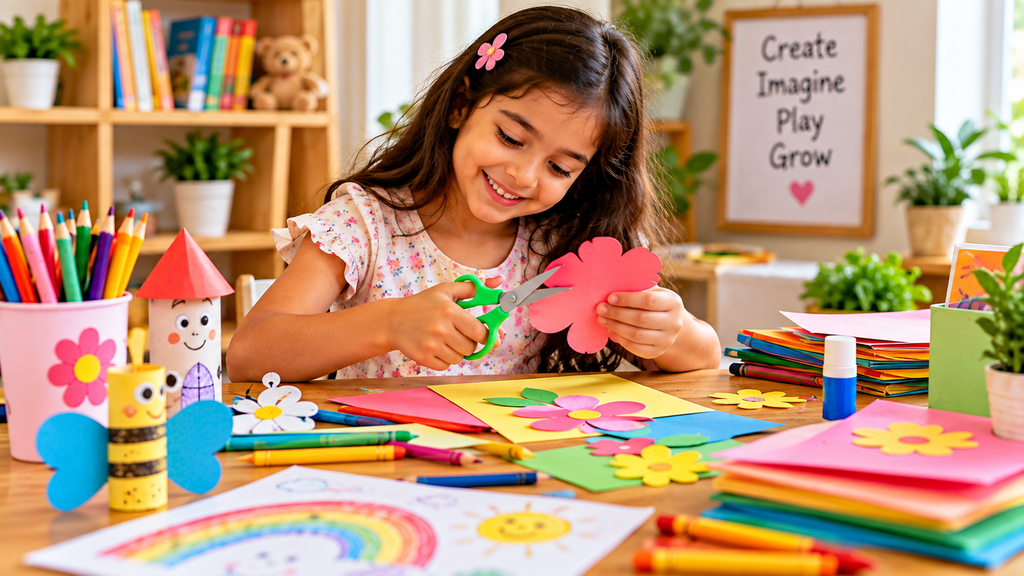
3. Make a Paper Craft
4. Design Your Own Coloring Page
5. Build Something With Recycled Materials
When Your Child Needs a Quiet Activity
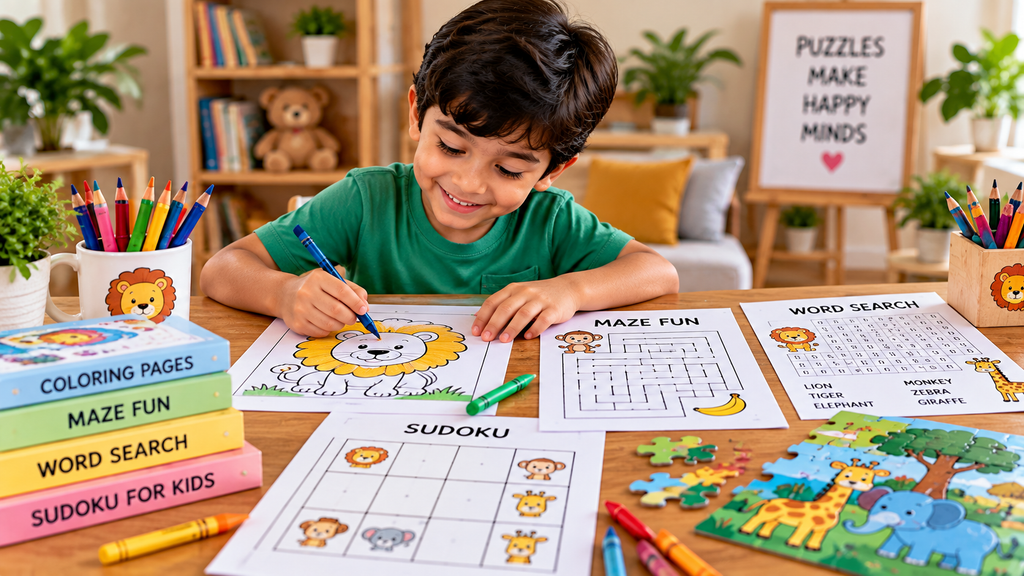
6. Try a Coloring Page
7. Solve a Maze
8. Complete a Word Search
9. Try a Kid-Friendly Sudoku Puzzle
10. Work on a Jigsaw Puzzle
When Learning Needs to Feel Like Play
11. Alphabet Hunt Around the House
12. Number Counting Challenge
13. Memory Matching Game
14. Shape Hunt
15. Create Your Own Math Game
When Kids Have Too Much Energy
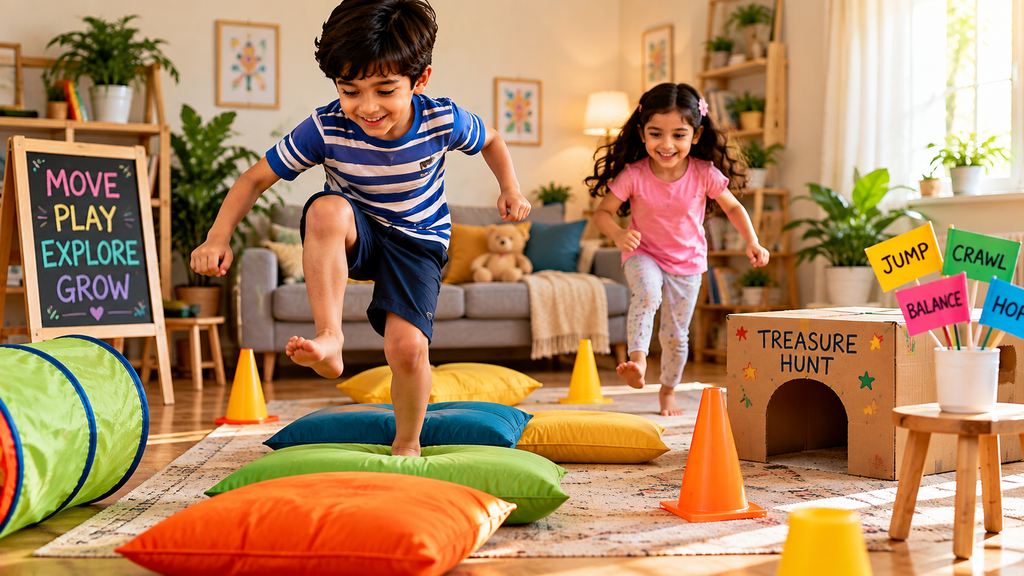
16. Create an Indoor Obstacle Course
17. Freeze Dance
18. Balloon Keep-Up Challenge
19. Animal Movement Game
20. Indoor Treasure Hunt
When the Whole Family Wants to Join
21. Make a Homemade Board Game
22. Family Storytelling Game
23. Act Out a Favorite Story
24. Build a Blanket Fort
25. Have a “Boredom Jar”
Screen-Free Activities for Preschoolers
Here we’ll specifically talk about ages 3–5, keeping activities simple and manageable.
Natural examples:
- coloring
- matching
- tracing
- counting
- sorting
- simple puzzles
- movement games
Screen-Free Activities for Kids Ages 6–9
Different needs:
- more challenging puzzles
- storytelling
- Dice games
- treasure hunts
- simple experiments
- writing/drawing challenges
- logic activities
This section makes the article useful beyond preschool parents.
What to Do When Your Child Says “I’m Bored”
This can be one of the strongest sections.
Instead of immediately giving another activity, explain how parents can create a “choice system.”
Example:
“Would you like to make something, solve something, move around, or explore?”
Then give 4 simple categories.
This makes the article feel more like parenting guidance, rather than a keyword article.
Create a Screen-Free Activity Box at Home
Practical section:
Keep a small box containing:
- crayons
- pencils
- scissors
- glue
- colored paper
- puzzles
- printable worksheets
- stickers
- play dough
- craft materials
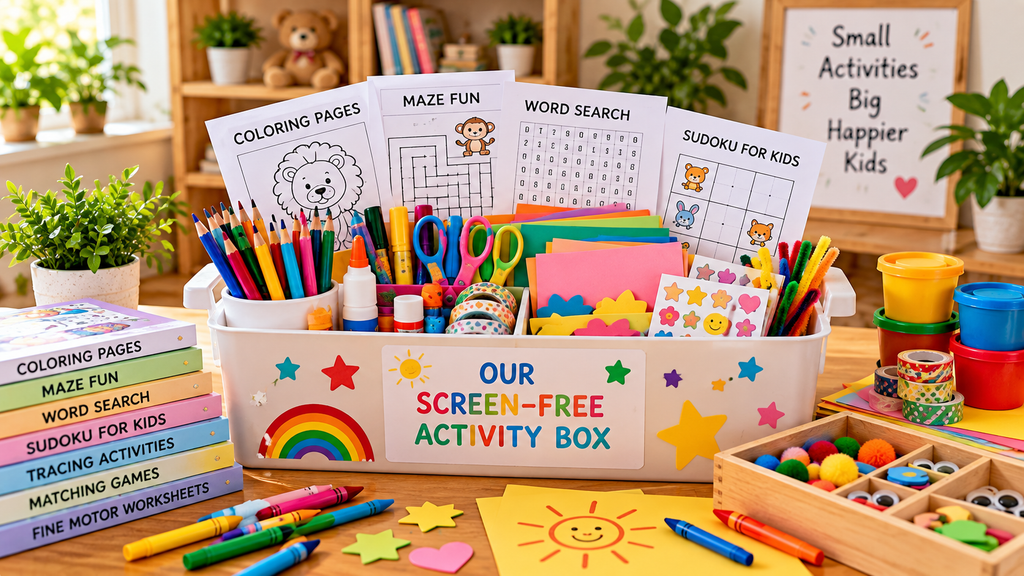
Then explain how parents can rotate materials so children don’t lose interest.
How to Make Screen-Free Activities More Interesting
This is another differentiated section.
Give Children a Choice
Add a Small Challenge
Let Kids Lead
Don’t Expect Every Activity to Work
That last point makes the article sound much more experienced and realistic.
Printable Screen-Free Activities for Kids
This is where ActivityNest fits naturally.
We can introduce:
- Coloring Pages
- Mazes
- Word Searches
- Sudoku
- Matching Games
- Fine Motor Worksheets
- Tracing Activities
- Connect the Dots
Each should have contextual internal links, not a random “click here” list.
A Simple Screen-Free Afternoon Routine
Rather than recommending strict screen-time schedules, give an example:
10 minutes: choose an activity
20 minutes: independent activity
15 minutes: movement
20 minutes: creative play
10 minutes: clean-up/read
And clearly state that families can adapt it according to age and routine.
Don’t Expect Every Activity to Work
This is important.
An activity that keeps one child occupied for an hour might hold another child’s attention for five minutes.
That doesn’t mean the activity failed.
Children have different interests, energy levels, ages, and moods.
The goal is to build a collection of possibilities rather than find one magical activity that works every time.
Screen-Free Does Not Have to Mean “Educational”
One common mistake is trying to turn every screen-free moment into a lesson. Children don’t need every minute of free time to have an obvious educational purpose.
Drawing a silly picture, building a blanket fort, pretending to run a restaurant, or making up a treasure hunt can simply be fun. Along the way, children may naturally practice communication, planning, creativity, coordination, and problem-solving.
The goal isn’t to replace every screen with another worksheet. The goal is to give children more interesting things to do.
Final Thoughts
End with the idea that screen-free time doesn’t need expensive toys or elaborate planning. Sometimes a box of crayons, a printable puzzle, a cardboard box, or a simple family game is enough to turn an ordinary afternoon into meaningful play.